Blog
From Virality to Veracity: How Misinformation Spreads
Understanding the machinery of false claims so we can slow them down.
The speed advantage of falsehoods
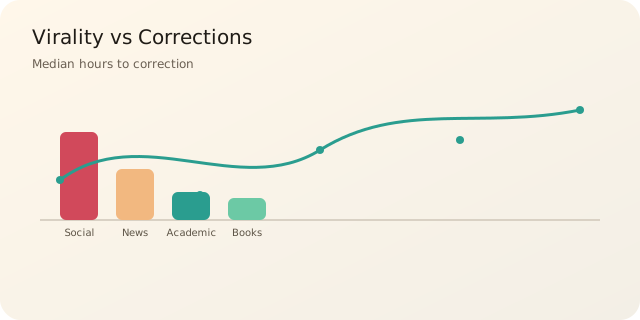
Misinformation travels faster because it is engineered for speed. Sensational claims are easier to share, require less context, and trigger stronger emotions. Platforms reward engagement, not accuracy, so the algorithmic incentives favor the most provocative narrative. When a claim spreads before verification can occur, the correction must work against a head start of millions of impressions. This is why verification must be proactive: if a system waits for virality to peak, it is already too late to shape public understanding.
From a user’s perspective, the difference is simple: it’s easier to tap “share” than to open five sources. Verification teams need to make the accurate path just as easy to follow.
Amplification channels matter
Not all channels amplify in the same way. Social platforms prioritize novelty and emotional response; news sites prioritize attention-grabbing headlines; messaging apps prioritize trust between peers. A robust fact verifier must understand these differences and tailor its research accordingly. Social signals can indicate which claims are gaining momentum, while traditional media helps establish the official record. The strongest verifiers cross-check across channels to reveal when a claim is being amplified in one arena but rejected in another.
When I see a claim trending on social but absent from reputable outlets, that gap is a signal by itself.
The role of synthetic media
Synthetic content accelerates misinformation because it looks authentic. AI-generated images, fabricated transcripts, and manipulated video clips can be produced at scale and distributed instantly. This means verification systems must incorporate source provenance checks, reverse image searches, and transcript validation. For contested claims, the verification workflow should require at least one independently validated source of record, such as a peer-reviewed study, official dataset, or direct statement from the original subject. This is critical to counter synthetic amplification.
In practice, the fastest filter is: can you trace it back to a primary origin? If not, it belongs in the “unverified” bucket.
Multi-agent verification as a countermeasure
A single analyst can be overwhelmed by a fast-moving narrative. Multi-agent verification distributes workload across sources: one agent checks social claims, another checks academic literature, another scans books and archives. This parallelism creates a timeline of evidence that is faster than a human-only process. When agents share their findings, they can surface contradictions early and converge on a verdict while the conversation is still forming. Speed plus transparency is the best response to virality.
Parallelism matters, but so does the handoff. The key is making sure the strongest evidence wins, not just the loudest agent.
Practical safeguards
Verification teams can reduce misinformation impact by setting clear thresholds for action: if a claim spreads beyond a certain velocity, trigger expedited multi-agent research. Maintain a database of repeated narratives to recognize re-emerging falsehoods. Publish findings with clear source links to make corrections easy to verify. The goal is not to chase every rumor, but to build a system that detects and neutralizes high-impact misinformation quickly and credibly.
A lightweight “fast pass” for high-impact claims has saved us hours of wasted effort on low-impact chatter.