Blog
The Case for Fact Verifiers in the AI Age
Why AI output needs structured verification to remain trustworthy.
AI is a powerful narrator, not a judge
Large language models can summarize complex topics at remarkable speed, but they are not inherently truth engines. They infer from patterns, not ground truth. This means they can be eloquent and wrong at the same time. As AI becomes embedded in research, media, and decision-making, the risk is not just hallucination—it is overconfidence in an unverified narrative. Fact verifiers add the missing layer: independent evidence collection, transparency about sources, and explicit reasoning about why a claim is accepted or rejected.
I treat AI as a fast briefing, not a final verdict. That mindset alone prevents a lot of bad calls.
Trust requires traceability
The defining feature of a trustworthy system is traceability. When an AI provides an answer, users need to see how it reached that answer. A fact verifier enforces this by requiring citations, logging source access, and displaying the reasoning path. This is the difference between a persuasive response and a defensible conclusion. In regulated industries and public decision-making, traceability is not optional. It is the basis for accountability and auditability.
If I can’t trace an answer back to a primary source, I treat it as a hypothesis, not evidence.
Multi-agent debate builds resilience
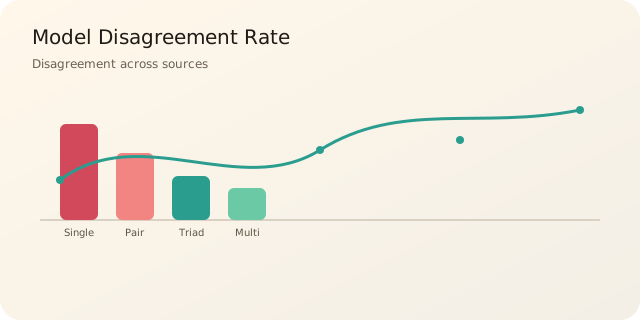
AI outputs are susceptible to bias and model drift. Multi-agent debate introduces structured dissent. When agents argue for and against a claim, they surface blind spots and reduce the chance of a single model dominating the verdict. This mirrors the scientific method: claims are tested, challenged, and corroborated across independent viewpoints. The result is a more resilient conclusion, not because AI is perfect, but because its errors are exposed through competition.
What I like about debate is that it captures uncertainty instead of flattening it. That makes the final summary more honest.
The role of high-quality sources
A verifier is only as good as its inputs. Access to academic papers, reputable news outlets, official datasets, and historical books enables the system to anchor claims in authoritative evidence. The AI layer then becomes a tool for synthesis rather than a generator of truth. The combination of broad source access and disciplined evaluation is what makes the AI age compatible with factual reliability.
If the sources are weak, the output will be weak. That’s why the tool mix matters as much as the model.
Implementation guidance
Organizations adopting AI should treat verification as a first-class feature. Build workflows that require evidence review before decisions are made. Use automation for discovery, but keep verification criteria human-readable and auditable. Over time, measure how often AI outputs are corrected by evidence and refine prompts and tools accordingly. The AI age is not the end of truth—it simply raises the bar for proof.
Start small: one workflow, one checklist, one set of sources. The habit is more important than the tooling.