Blog
Why Multi-Agent Debate Beats Single-Model Answers
Consensus emerges when evidence competes, not when one answer dominates.

Single answers hide uncertainty
When a single model provides a response, the uncertainty is often invisible. The output may sound confident even when evidence is weak. Multi-agent debate forces uncertainty into the open by making agents argue from different positions. If an agent cannot defend a stance with evidence, its weakness becomes visible. This creates a more honest outcome because disagreement is surfaced rather than suppressed.
I prefer seeing disagreement over a polished answer that hides doubts. It makes the conclusion feel earned.
Debate is a quality control mechanism
Debate is not just rhetorical; it is an engineering tool for error correction. Each agent is motivated to find the strongest evidence for its assigned stance, which expands the search space and reduces confirmation bias. When agents exchange findings, they can challenge each other’s evidence and expose gaps. The final vote is more robust because it reflects a contest of evidence rather than a single narrative.
If one agent can’t defend a claim under pressure, that’s a signal to slow down.
Parallelism scales verification
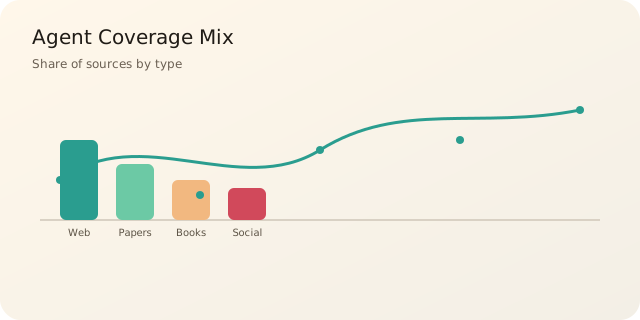
Multi-agent systems naturally scale. Instead of a single model scanning all sources, you distribute tasks: one agent handles academic papers, another checks web and news, another scans books and archives. This parallel approach shortens verification time while increasing coverage. It also encourages specialization, because agents can be tuned to the toolset and source type they are best suited to handle.
Parallelism only helps if each agent has a clear job. Otherwise you just get duplicated work.
Weighted voting balances expertise
Not all agents are equal. Some models are stronger, some are cheaper. A well-designed system weights votes based on model capability, while still preserving diversity of perspective. This is analogous to expert panels where specialist opinions carry more weight. The outcome is neither purely democratic nor purely authoritarian—it is an evidence-weighted consensus.
Weighted voting avoids the trap of “majority wins” when the majority is under-informed.
Designing a healthy debate
The quality of debate depends on rules. Agents should be required to cite sources, avoid fabricated facts, and revise their vote when new evidence appears. Limiting rounds prevents infinite loops, while allowing a few iterations encourages refinement. A healthy debate ends with either consensus or a transparent split decision that explains the reasoning on each side.
A clean transcript of who argued what is just as valuable as the final verdict.