Blog
MCP + Open Tools: Source Diversity Wins
Why source variety is a competitive advantage in verification.

The danger of narrow source pools
A verification system that relies on a single dataset is brittle. Every data source has blind spots, biases, and update gaps. If your system only looks at a limited slice of the world, it will fail on edge cases and evolving narratives. Source diversity is a safeguard against these weaknesses because it forces the system to cross-check across independent pools of knowledge.
I’ve watched the same claim flip from “true” to “false” just by adding one additional source category. That’s a red flag for narrow inputs.
MCP unlocks breadth
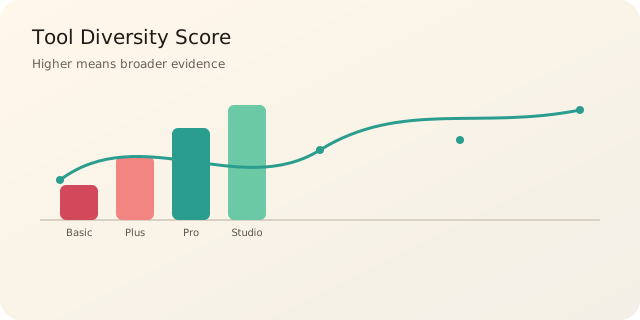
The Model Context Protocol enables structured access to multiple tools and sources. Instead of a monolithic search, agents can query academic databases, open access journals, book catalogs, and specialized archives. This breadth matters because different claims require different evidence. A policy question may need academic references, while a historical claim may require books or archival materials. MCP makes it possible to tailor the evidence pipeline to the question.
It feels obvious once you use it: different questions need different shelves.
Verification is a sourcing strategy
The key question for any verifier is not just “Is this true?” but “Which sources can credibly answer this?” A diverse toolchain allows the system to match claims with the most authoritative sources. For example, scientific claims should prioritize peer-reviewed literature, while cultural or historical claims may require books and archival records. A good verifier is therefore a sourcing strategy, not just a search function.
When the source is wrong for the question, even perfect reasoning fails.
Reducing single-point failure
Source diversity protects against outages, paywall limitations, and biased datasets. When one source fails or is incomplete, other sources can fill the gap. This redundancy makes the verification process more resilient, especially for fast-moving claims where time is critical. It also prevents over-reliance on a single provider whose data may be skewed or outdated.
Think of it like redundancy in engineering. One broken feed shouldn’t collapse the whole verdict.
Operational best practices
To maximize source diversity, build tool categories, enforce coverage rules, and log which sources were used. Encourage agents to pull evidence from at least two independent domains before finalizing a vote. Over time, track which sources consistently produce reliable evidence and elevate their weighting. Diversity is not just about volume—it is about meaningful, independent corroboration.
Even a simple rule like “two categories minimum” changes outcomes for the better.