Blog
Transparency as Trust: Showing Sources and Votes
Visibility into evidence and reasoning is the foundation of credibility.
Opaque answers erode trust
When users are given a verdict without evidence, they are asked to take the system on faith. That might work once, but it does not build lasting trust. Transparency changes the dynamic: users can see the sources, the reasoning, and the vote distribution. This makes the result inspectable and defensible.
I’m far more likely to accept a conclusion if I can click through to the sources myself.
Votes reveal uncertainty
A split vote is not a failure—it is a signal. It tells users where evidence is contested and where further research is required. Publishing vote distributions helps teams make informed decisions rather than pretending every conclusion is absolute. It also reduces overconfidence, which is a major source of errors in decision-making.
Seeing the disagreement is useful because it sets expectations: this is a gray zone, not a slam dunk.
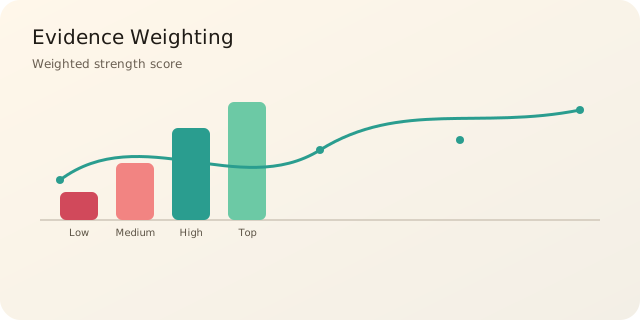
Source lists are accountability tools
Providing source links is not only for readers; it is a form of accountability for the system itself. When sources are logged and visible, the system can be audited and improved. Over time, patterns in source quality emerge, enabling the verifier to prioritize stronger evidence and reduce reliance on weaker sources.
If a source list looks thin, that’s a red flag to pause before acting.
Explainability builds adoption
Executives and analysts are more likely to adopt a verification system if it explains its reasoning clearly. A simple summary is not enough; the system should show the evidence trail, the strongest arguments, and the reasoning behind each vote. This converts verification from a black box into a decision support tool.
Clear reasoning beats a clever output every time.
Designing for transparency
Transparency must be built into both the backend and the UI. Capture tool usage, log URLs accessed, and store vote reasoning. On the front end, present this data in an accessible format: summaries, expandable vote details, and source lists. Transparency is not a feature—it is the foundation of trustworthy verification.
The UI is part of the trust model, so it can’t be an afterthought.